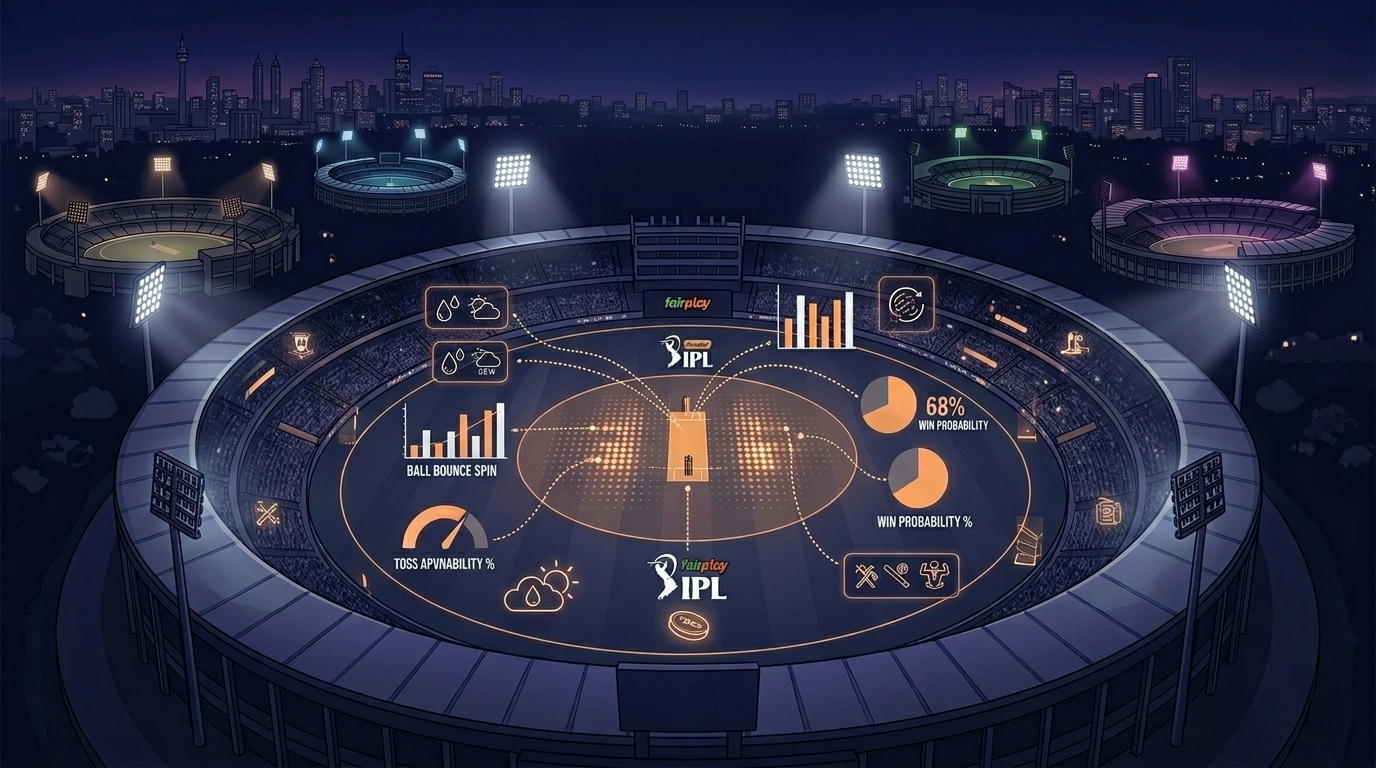
The Indian Premier League (IPL) has become a data-driven competition wherein team performance is determined by not just the strength of the team but also external factors including the conditions of the venue, the behavior of the pitch, and other environmental elements. The new IPL 2026 will be of multi venue type around India with matches in stadiums such as M. Chinnaswamy stadium, Wankhede stadium, Eden Gardens, Narendra Modi stadium among others, which have different playing conditions that directly influence the match results and betting markets.
Venue based win probability models are very important to experienced traders and analysts in order to refine their predictions in IPL matches and enhance the accuracy of their cricket match predictions as well as finding value in T20 betting predictions and IPL betting tips today.
This blog covers the effects of venue specific conditions on the probability of winning IPL, the construction of a structured prediction model and the ability of traders to use venue intelligence to provide an advantage in the current IPL forecast.
Venue-based analysis is interested in the behavior of a particular stadium in the context of a match. The ground-specific patterns used in venue-based models include, unlike neutral statistical models:
Different IPL grounds would create different scoring conditions, something that influences pre-match odds as well as the in-play betting pattern.
In the case of Wankhede and Chinnaswamy, chasing teams are usually favored because of the shorter boundaries and effects of dews, whereas a slower pitch such as Chennai would favor spinners and lower totals.
IPL 2026 has matches dispersed in various venues such as Bengaluru, Mumbai, Chennai, Delhi, Ahmedabad, Kolkata, Lucknow, Hyderabad to name a few.
It is the multi-venue structure that requires venue modeling to predict correctly.
A professional venue based model is a combination of multiple weighted variables. These inputs are used to approximate probabilities by traders instead of depending on traditional match previews.
All pitches can be categorized as follows:
Older scoring patterns of the venue are used to determine a pitch behavior score which in turn affects the projected totals and win percentages.
Tosses are an important factor in IPL games. In places where there is dew, the winning team in the toss of a dice tends to bowl first.
The model incorporates:
Certain teams have been found to be more effective at some venues by virtue of familiarity.
Examples:
This information can be directly used to change the probability of winning the IPL.
The behavior of pitch and balls is affected by humidity, temperature, and the dew.
Today IPL forecasts are sharper when using weather-adjusted models.
Team balance matters:
Such a correlation between the composition of squads and the type of venue plays an important role in the IPL match predictions.
For traders:
Trading insight:
Trading insight:
Trading insight:
Big ground with variable pitch action.
Can be used to support high and moderate scoring according to the preparation of the surface.
Trading insight:
Most experts in the trade and analyst rely on frameworks instead of using intuition.
Past performances by the club at the stadium.
Assign weights to:
Calculate weighted variables to determine:
The foundation of IPL match predictions and trading is based on this.
Venue models are not limited to pre-match predictions. They also enhance live trading strategies.
For example:
These signals help traders adjust positions dynamically in T20 betting predictions.
Betting markets react to:
Venue-based models help identify discrepancies between actual probability and market odds.
If the model suggests a 65 percent win probability but the market reflects 50 percent, a value betting opportunity exists.
This concept is central to professional-level trading and improves consistency in cricket match prediction strategies.
Venue-based models also contribute to risk control:
This structured approach ensures more disciplined trading rather than emotional decision-making.
The IPL 2026 season features matches across multiple cities with a mix of traditional home grounds and secondary venues.
The league stage spans several weeks with over 70 matches scheduled across venues with varying conditions.
Additionally, teams are adapting to:
Recent updates indicate injury concerns and squad adjustments across franchises, which can affect team balance and venue performance outcomes.
These factors make venue-based modeling even more important for accurate IPL betting tips today and forecasting outcomes.
At Fairplay, we believe in maintaining a balanced and responsible approach to betting analysis. We focus on providing structured insights that help users make informed decisions rather than relying on speculation or impulsive choices. Our approach emphasizes transparency in odds interpretation, disciplined risk assessment, and consistent evaluation of match conditions. We encourage users to treat betting as a calculated activity where data, logic, and venue-based understanding work together to improve decision-making quality.
Venue-based win probability models are a cornerstone of modern IPL analysis. For experienced traders, these models provide a structured way to interpret conditions, assess probabilities, and identify value in betting markets.
By combining venue data, team performance, toss impact, and environmental factors, traders can refine their IPL match predictions, improve IPL winning probability estimates, and enhance both pre-match and live strategies.
In a tournament like IPL 2026, where matches are played across diverse venues and conditions, venue intelligence becomes a decisive factor in building consistent and profitable approaches to T20 betting predictions and overall match forecasting.
Venue-based win probability models analyze historical and contextual data from a specific stadium to estimate match outcomes. In the context of the Indian Premier League, these models consider pitch behavior, toss impact, weather conditions, and team performance at that venue to improve IPL match predictions.
Each IPL venue has unique characteristics such as pitch speed, boundary size, dew factor, and scoring patterns. These factors influence batting and bowling performance, making venue a key variable in determining IPL winning probability and refining today IPL forecast accuracy.
Toss plays a significant role, especially in night matches where dew becomes a factor. At certain venues, teams chasing have a statistical advantage. Venue-based models include toss win data and chasing success rates to improve cricket match prediction outcomes and T20 betting predictions.
These models typically use:
All these inputs help in generating more accurate IPL match predictions and identifying value in betting markets.
Yes. Venue-based insights are widely used in IPL betting tips today to identify mismatches between market odds and actual probability. Traders use these models to spot value bets, assess risk, and make more informed decisions in both pre-match and live betting scenarios.